
Vale Sangora Exploration Guide: Regions, POIs, Fast Travel and Difficulty
How Dawnwalker's map reveals activities, how region difficulty is set, which POIs exist, how fast travel works and why exploration doesn't always cost time.
Updated 2026-09-12
The game is now available on PC, PlayStation 5 and Xbox Series X|S. This guide keeps exact costs, locations and route requirements conservative until they are separately verified in the retail build.
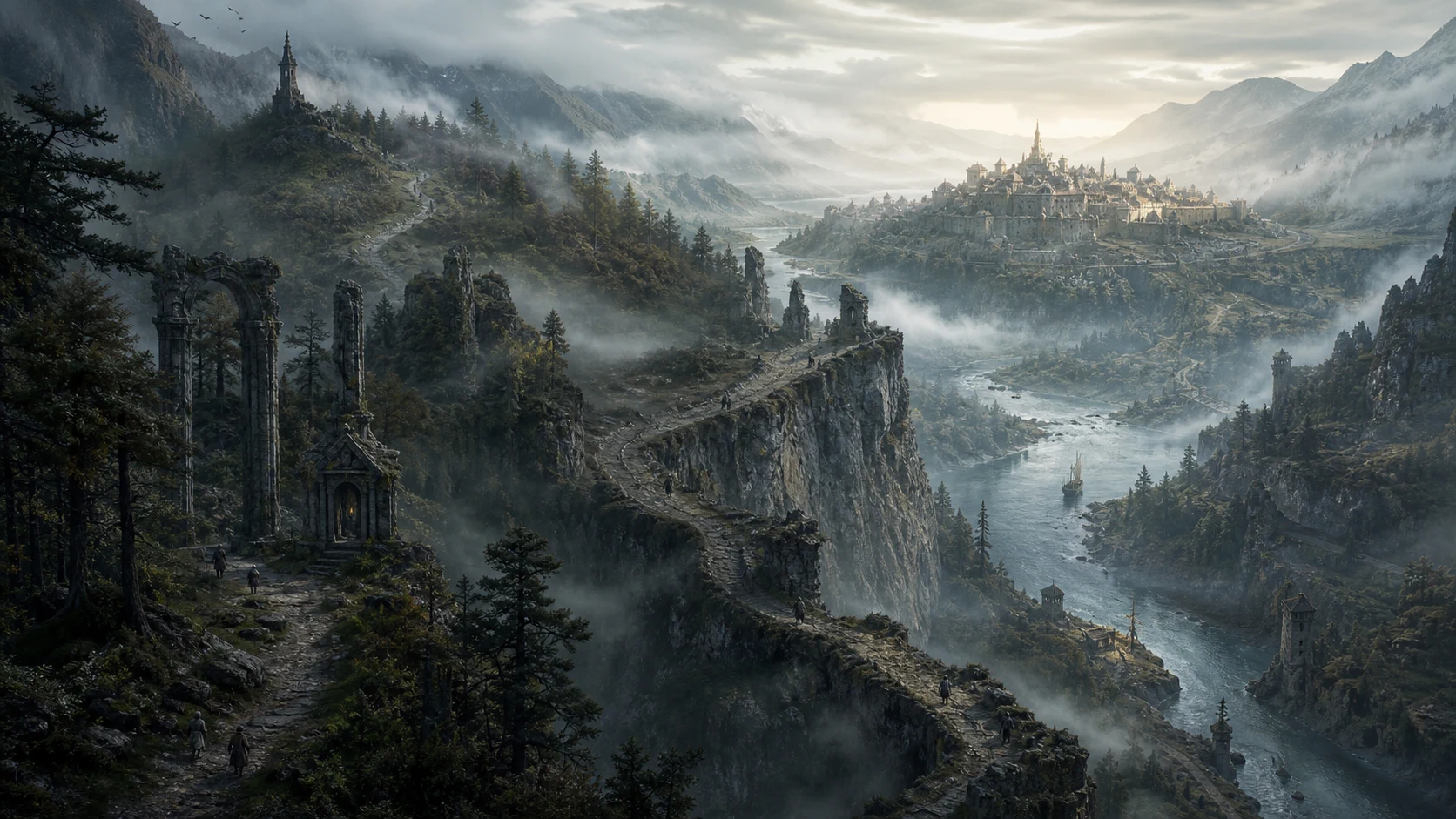
Vale Sangora is designed for scouting before committing. The world map is visible from the start, but important activities are not fully labeled until you discover enough information.
Entering a new area can reveal that something is happening nearby without telling you exactly what it is. Clues, locals and direct exploration fill in the details.
Confirmed location types
Vale Sangora includes settlements, villages, ancient crypts and ruins across swamps, forests, mountains, caves and meadows. Discoverable activities can include:
- shrines
- military or bandit camps
- monster nests
- haunted places
- hidden treasures
- merchants and specialized shops
- activity hints that only become specific after investigation
Svartrau is the main city and the broadest merchant hub in Vale Sangora.
Map facts
World size:      roughly 10 km² of open valley [RETAIL-REVIEWED]
Region name:     Vale Sangora (Sangora Valley)
Main city:       Svartrau
Mounts:          none — no horses, no mounts of any kind [RETAIL-REVIEWED]
Map revealing:   climb towers to scout and survey surrounding areas
Fast travel:     wayside shrines (see below)
The no-mounts fact surprises most new players: Vale Sangora is built to be crossed on foot, and the traversal skills you unlock later are the real “mount system”. The world is small enough (about 10 km²) that walking stays viable once you know the routes.
Region difficulty
Regions have minimum and maximum difficulty boundaries. An area’s difficulty is set based on your level the first time you enter and then remains fixed for that playthrough.
The broad progression trend gets harder farther south, but the map does not physically stop you from walking into dangerous areas early.
Practical implication: if you want a region to stay challenging, do not assume it will continuously scale with you after first entry.
Fast travel: the shrine network
Fast travel in retail runs through wayside shrines scattered across the valley:
- Activate a shrine by interacting with it — an inactive shrine is not a fast travel point yet.
- Fast travel happens from a shrine, to a shrine. You cannot teleport from an arbitrary spot on the map; walk to your nearest activated shrine first.
- Selecting an unlocked shrine on the map moves you there. Travel itself does not consume narrative time, while some actions used to activate or repair points can.
That “from a shrine, to a shrine” rule is the one that catches new players: if you are standing in a swamp and want to teleport back to Svartrau, the first move is reaching your nearest active shrine, not opening the map.
Until your shrine network fills in, two accelerators matter:
- Vampire traversal at night — Shadowstep, Clawride and Planeshift change how you move through vertical spaces (see the day/night guide). If a route looks inaccessible during the day, revisit it after dark before assuming there is a missing key.
- Towers — climbing a tower scouts and surveys the surrounding area, which both reveals the map and helps you plan a walking route worth taking.
Because exact shrine-by-shrine locations are still being catalogued, this site does not publish an interactive map with guessed markers. We would rather give you the system than invented coordinates — the marker-level map goes up when the locations can be cited.
Exploration and the 30-day clock
You can explore in real-world time without an always-running narrative clock. Time advances at specific activities, indicated by the hourglass system.
That makes reconnaissance unusually valuable: you can discover the shape of an opportunity before deciding whether the timed action is worth taking.
Day/night traversal
Vampire abilities such as Shadowstep, Clawride and Planeshift change how you move through vertical spaces at night. If a route looks inaccessible during the day, revisit the location after dark before assuming there is a missing key.